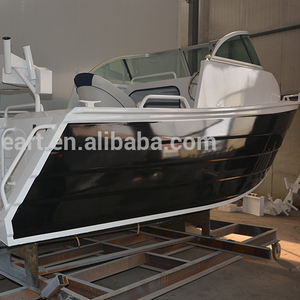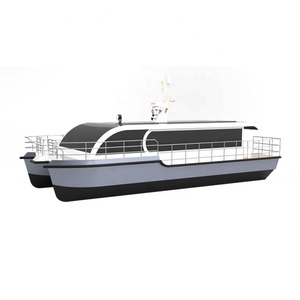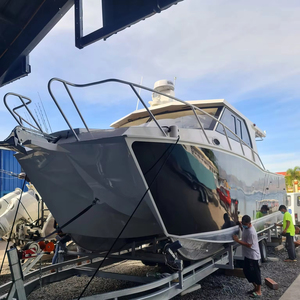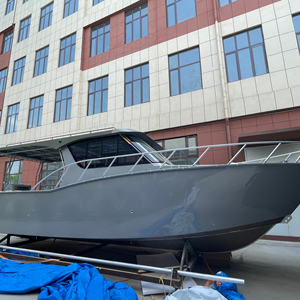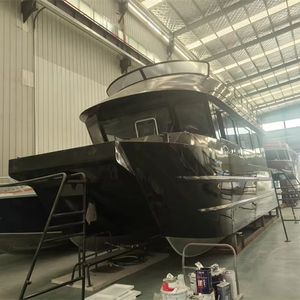
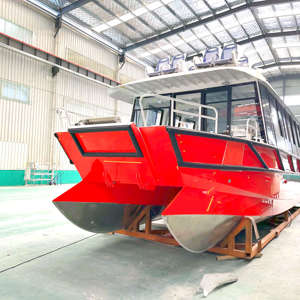
Explore our engineered range of commercial marine craft, high-grade aluminum passenger catamarans, and integrated Full Container Load (FCL) / Flat Rack ocean charter logistics options designed for international procurement teams.
Operating at the intersection of heavy marine manufacturing and end-to-end transpacific logistics, our enterprise bridges the historical gap between OEM/ODM factory-floor production and destination port clearance. Founded on over four decades of maritime cargo and vessel fabrication leadership, Intertrans Group alongside Gospel Boat/Furreo shipyards delivers an end-to-end solution for international commercial buyers, marine charter operators, and municipal fleet buyers.
When procuring commercial vessels—such as 11.6m center console catamarans, 9m luxury aluminum fishing yachts, or 18m passenger ships—logistical friction routinely represents up to 22% of landed costs. As an FMC-Licensed NVOCC (Non-Vessel Operating Common Carrier) and CTPAT-Certified Partner, we directly issue negotiable Master Bills of Lading, file automated 24-Hour Advanced Manifest Systems (AMS) and Importer Security Filings (ISF) in-house, and handle out-of-gauge (OOG) containerized packaging directly from our fabrication facilities in Qingdao to destination docks worldwide.
By owning and operating dedicated regional offices in primary logistical gateways, we maintain 24-hour continuous surveillance over both manufacturing workflows and marine transshipments.
In modern commercial vessel fabrication, the transition from legacy fiberglass (GRP) to high-tensile marine aluminum alloys represents a paradigm shift in lifecycle economy and freight durability. Modern OEM/ODM factories utilize precision CNC plasma cutting and automated MIG/TIG robotic welding to process 5083-H116 plate aluminum. This specific alloy exhibits exceptional resistance to stress corrosion cracking in extreme marine salinity while maintaining superior yield strength (≥ 215 MPa).
From an FCL logistics standpoint, aluminum hulls provide a critical weight-saving advantage of 35% to 45% compared to equivalent fiberglass vessels. This reduction directly translates into lower gross weight metrics for ocean freight calculations, enabling multi-unit consolidation within 40’ High Cube (HC) or specialized 40’ Flat Rack (FR) container gear without breaching maximum road axle weight regulations during destination drayage.
Transporting high-value commercial vessels—ranging from 5m mini cuddy cabins to 11.6m luxury sport catamarans—demands rigorous container stowage planning. Standard ISO intermodal equipment selection is governed by vessel beam, bridge clearance, and total displacement:
| Vessel Specification Range | Optimal Ocean Equipment | Stowage Method & Packaging Protection | Max Weight / Cube Efficiency |
|---|---|---|---|
| Beam < 2.28m | Length < 5.8m (e.g., 5m Cuddy Cabin) | 20' GP / 40' HC Standard Dry Container | Internal custom steel cradle with rubber dampeners; shrink-wrap heat seal. | Up to 3 Units stacked per 40' HC container. |
| Beam 2.3m - 2.5m | Length 8m - 11.6m (e.g., 9m-11m Catamarans) | 40' High Cube (HC) / Angled Cradle | Tilted structural framing (45-degree angle loading) to fit within 2.58m door height. | 1 Unit + spare outboard engines & OEM parts box. |
| Beam > 2.8m | Height > 3.0m (e.g., Commercial Charter Ships) | 40' Flat Rack (FR) / Open Top (OT) / Breakbulk | Over-dimensional lashings with certified 50kN polyester webbing & steel wire turnbuckles. | Out-of-Gauge (OOG) special project cargo handling. |
For Out-of-Gauge (OOG) shipments on Flat Racks, our engineering teams construct custom heavy-duty steel cradles equipped with anti-vibration neoprene pads. Lashing points are pressure-tested to withstand longitudinal accelerations up to 2.0g and transverse forces up to 1.0g encountered during severe North Pacific winter transits.
The global marine chartering market and industrial vessel procurement sector are undergoing rapid transformation driven by regulatory decarbonization mandates, smart factory integration, and shifting geopolitical supply chain corridors. B2B buyers must align their multi-year procurement roadmaps with three core macro trends:
The International Maritime Organization's (IMO) updated GHG Strategy mandates a 40% carbon intensity reduction by 2030. Carrier networks are deploying dual-fuel LNG and green methanol container vessels. For OEM/ODM vessel buyers, this translates to green freight surcharges but also introduces carbon footprint accounting metrics on Master Bills of Lading. Light-weight aluminum hull designs directly lower operational fuel burn, aligning charter fleets with Scope 1 carbon mitigation targets.
To maximize FCL container volumetric utilization, top-tier Chinese manufacturers (e.g., Qingdao shipbuilding hubs) are shifting toward Complete Knock-Down (CKD) and Semi-Knock-Down (SKD) modular vessel architectures. Hull sections, center consoles, and hardtop T-tops are engineered for rapid bolted assembly at destination ports, allowing 200% higher packing density inside standard 40’ HC containers and slashing per-unit ocean freight costs by up to 45%.
Future-proof procurement contracts require real-time visibility. Modern FCL container shipments are equipped with IoT-enabled sensor pods monitoring shock, humidity, pitch, roll, and GPS coordinates during maritime transit. Freight forwarding nodes (such as Intertrans Express’s tracking matrix) feed telemetry directly into enterprise ERPs, guaranteeing that pre-delivery inspections (PDI) at factory gates match post-transit delivery standards.
Commercial fishing and leisure charter operators in North America and Europe are rapidly adopting dual 250HP to 300HP outboard setups integrated with lithium-iron-phosphate (LFP) battery banks for quiet zero-emission harbor maneuvering. OEM factories are custom-molding transom structures to handle increased static weight load and torque dynamics of high-horsepower electric-hybrid outboards.
An FMC (Federal Maritime Commission) licensed NVOCC (Non-Vessel Operating Common Carrier) is legally authorized to issue its own negotiable Master and House Bills of Lading, publish tariffs, and enter into direct service contracts with vessel-operating ocean carriers (VOCCs). Unlike standard brokers who act merely as intermediaries, an NVOCC assumes primary carrier liability for the cargo from origin dock to destination door. This ensures strict regulatory compliance, direct control over space allocations during peak shipping seasons, and seamless handling of U.S. Customs CTPAT security protocols.
Vessels exceeding standard container door widths (2.34m) are engineered for angled cradle stowage. The boat is secured onto a certified heavy-duty steel jig tilted at a precise 35-to-45-degree angle inside a 40' High Cube container. For catamarans with beams exceeding 3.2m, out-of-gauge (OOG) shipping on a 40' Flat Rack or dedicated Breakbulk vessel is utilized. All securing utilizes 50kN-rated synthetic webbing, steel turnbuckles, and marine shrink-wrapping to prevent saltwater mist exposure.
Mandatory documentation includes: (1) Commercial Invoice and Detailed Packing List specifying engine serial numbers and hull identification numbers (HIN); (2) Bill of Lading (NVOCC Issued); (3) CE Certificate / Declaration of Conformity for EU markets or USCG Compliance Certification for US waters; (4) Manufacturer’s Statement of Origin (MSO); (5) ISF 10+2 filing submitted at least 24 hours prior to origin vessel loading; and (6) EPA Engine Declaration forms (Form 3520-21) for motorized vessels.
Standard OEM/ODM production lead time for commercial aluminum boats (such as 9m to 12m fishing catamarans) typically ranges between 60 to 90 days, depending on custom console layouts, hardtop installations, and engine rigging requirements. Ocean transit times average 14 to 22 days for Asia-to-US West Coast (LA/Long Beach), 28 to 35 days for US East Coast (NY/NJ), and 30 to 40 days for main European base ports (Rotterdam/Hamburg).
Yes. Built-in fuel tanks must be fully purged and certified gas-free prior to container packing (under IMDG Code Special Provision 961/962). Installed lithium battery storage banks are classified under UN 3481 (Lithium ion batteries contained in equipment) and require certified Dangerous Goods Declarations (DGD), UN-approved protective packaging, and appropriate Hazmat labeling on the exterior of the FCL container. Our operations team holds certified IATA/IMDG dangerous goods credentials.
Landed cost optimization is achieved through structural nesting and consolidated FCL ordering. By procuring 3 to 4 smaller units (e.g., 5m cuddy cabins) alongside 1 larger vessel, or opting for SKD (Semi-Knock-Down) T-top assemblies, buyers can maximize the cubic meter utilization of a 40' High Cube container. This drastically reduces the per-unit ocean freight cost compared to shipping single boats via LCL or open breakbulk.