Direct Factory Sourcing & Specialized Out-of-Gauge (OOG) Shipping Solutions for the Argentine Industrial Sector



Argentina’s industrial sector is undergoing a profound structural transformation driven by extensive capital investments in energy infrastructure, mining, agriculture, and manufacturing modernization. From the vast energy reserves of the Vaca Muerta shale formation in Neuquén to the rapidly developing Lithium Triangle across Jujuy, Salta, and Catamarca, the demand for high-capacity, heavy-duty industrial machinery, processing plants, and structural steel components has reached unprecedented heights.
As Argentine enterprises seek reliable manufacturing partnerships, Chinese original equipment manufacturers (OEMs) and engineering factories have emerged as the primary source for high-specification heavy lift machinery. However, procuring out-of-gauge (OOG) equipment directly from Chinese manufacturers involves complex supply chain dynamics. Procuring heavy machinery is not merely a purchasing transaction; it requires a integrated framework combining precision engineering, international maritime logistics, customs regulatory compliance, and localized inland transport engineering.
Demands heavy drilling rigs, frac pumps, heat exchangers, and processing pressure vessels transported to deep inland oilfields in Neuquén under stringent safety standards.
Requires massive rotary kilns, crystallizers, filter presses, and structural modular plants transported across high-altitude Andean routes (Puna region) requiring detailed route surveys.
Requires automated grain processing complexes, oversized storage silos, and agricultural machinery assemblies delivered directly to the agricultural heartland of Santa Fe and Córdoba.
Shipping oversized cargo from Chinese industrial hubs (such as Shanghai, Ningbo, Qingdao, and Guangzhou) across the Transpacific ocean routes to the South Atlantic port of Buenos Aires demands strict adherence to international ocean freight standards. Miscalculating cargo dimensions, center of gravity (COG), or failing to apply adequate corrosion protection can lead to catastrophic maritime losses or expensive customs rejections at Argentine terminals.
When contracting Chinese manufacturers for heavy machinery, selecting the appropriate equipment mode is critical to optimizing landed cost and safety:
| Equipment Type | Dimension & Weight Scope | Ideal Industrial Cargo Application | Lashing & Securing Standard |
|---|---|---|---|
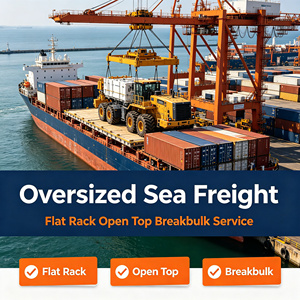
| Flat Rack Containers (20' / 40' FR) | Over-width (>2.35m) and over-height (>2.25m) cargo up to 45 metric tons | Heavy excavators, industrial boilers, heavy transformers, large stamp presses | Steel chain binders, heavy-duty polyester webbing, anti-slip rubber pads (ISO 1496-5) |
| Open Top Containers (20' / 40' OT) | Over-height cargo loaded by overhead crane through the top roof tarpaulin | Tall vertical machinery, glass manufacturing units, heavy mechanical arms | TIR-approved tarpaulins, internal lashing rings rated to 2,000 kg each |
| Breakbulk & Heavy Lift Vessels | Non-containerizable units (>50 tons or exceeding 12m length x 4m width) | Complete refinery columns, mining ball mills, wind turbine blades and towers | Custom steel cradle fabrication, lifting beam calculations, marine warranty surveyor oversight |
| Ro-Ro (Roll-on / Roll-off) | Self-propelled or towable wheeled/tracked heavy machinery | Mining dump trucks, mobile cranes, agricultural harvesters, crawler tractors | Direct deck pad eye securing, wheel chocks, weather-protected lower deck placement |
The maritime route from East Asia to Argentina crosses multiple climate zones, creating extreme relative humidity variations inside container holds and weather decks. Direct factory packaging in China must incorporate VCI (Vapor Corrosion Inhibitor) heat-sealed barrier bags, heavy desiccant packs, and marine-grade shrink wrap to prevent saltwater oxidation on machined steel surfaces during the 40 to 50-day transit.
Delivering oversized cargo to Argentina does not end with vessel discharge at port. The inland infrastructure of South America presents unique transport challenges, including bridge load limits, low-overhead powerlines, narrow toll plazas, and strict regulatory weight enforcement by Vialidad Nacional (National Road Directorate).
Primary clearance takes place at Puerto de Buenos Aires (Dock Sud / Terminales Rio de la Plata) or Puerto Zárate. Specialized multi-axle drayage vehicles are required immediately upon quay release to avoid heavy terminal storage demurrage.
For lithium projects in Salta and Jujuy, cargo must traverse steep incline highways reaching over 4,000 meters above sea level via Ruta Nacional 51. Specialized low-boy hydraulic modular trailers are deployed to maintain stability.
Heavy oilfield equipment routed to Vaca Muerta utilizes Ruta Nacional 151 and Ruta 22. Sweeping permits for over-dimensional convoys must be scheduled weeks in advance with provincial police escorts.
| China Port of Loading (POL) | Argentina Port of Discharge (POD) | Shipping Mode | Average Ocean Transit Time | Total Door-to-Door Lead Time |
|---|---|---|---|---|
| Shanghai / Ningbo | Buenos Aires (TRP / Exolgan) | Direct Ocean Liner (FCL / OOG) | 35 - 42 Days | 45 - 55 Days |
| Qingdao / Tianjin | Zárate Multimodal Terminal | Breakbulk Project Vessel | 40 - 50 Days | 52 - 65 Days |
| Guangzhou / Shenzhen | Bahía Blanca (Industrial Hub) | Transshipment Ocean Express | 38 - 45 Days | 50 - 60 Days |
Navigating Argentine trade compliance requires an intimate understanding of evolving regulatory frameworks managed by **ARCA (Agencia de Recaudación y Control Aduanero)**, formerly AFIP, alongside Central Bank of the Argentine Republic (BCRA) foreign exchange regulations.
As an **FMC-licensed NVOCC** and **CTPAT-certified global logistics partner** with over four decades of operational excellence, Intertrans Express Inc. bridges the gap between Chinese heavy equipment manufacturers and Argentine enterprise buyers.
Guarantees audited origin-to-destination security protocols, reducing customs physical inspection frequencies and expediting terminal release cycles.
We issue our own legally binding NVOCC House Bills of Lading, ensuring strict control over cargo release, title transfer, and financial security.
With direct offices in North America and Asia, backed by long-standing South American agent networks, we provide 24/7 bilingual tracking and operational oversight.
Expert Solutions to Common Challenges Faced by Argentine Importers Sourcing Chinese Industrial Cargo
Answer: The transition to the SEDI system has streamlined the prior approval process compared to the old SIRA regime. However, accurate documentation—including technical datasheets, certified HTS classification, and exact valuation—must be submitted prior to loading in China. Working with a freight forwarder that manages pre-filing compliance prevents cargo from being held at the Port of Buenos Aires under costly terminal demurrage.
Answer: Cost efficiency depends on the exact physical envelope (length, width, height, weight) of the machinery. Cargo that can fit on Flat Rack (FR) or Open Top (OT) containers generally benefits from scheduled container liner services with lower freight rates and frequent sailings. For massive, non-containerizable equipment exceeding 50 metric tons, chartering Breakbulk space or utilizing Ro-Ro (for wheeled units) provides the safest and most economical door-to-door cost structure.
Answer: Yes. Our logistics engineering team handles complete route surveys, bridge load assessments, highway permits from Vialidad Nacional, and coordinates specialized hydraulic multi-axle modular trailers. We manage the entire inland transit chain, including escort vehicles (coordinación vial) required for high-altitude Andean deliveries.
Answer: Under DAP terms, the buyer handles local Argentine import taxes, VAT, and customs duties directly with ARCA in local currency (ARS), while international freight and origin charges are settled via established foreign exchange mechanisms. For DDP arrangements, our team assists in structuring compliant logistics contracts that align with Central Bank (BCRA) foreign exchange payment timelines.
Answer: We require Chinese factories to execute seaworthy export packaging. This includes vacuum-sealed VCI foil wrapping around sensitive electronic and mechanical components, heavy-duty wooden crate framing compliant with ISPM-15 heat treatment standards, and customized structural steel cradles to secure heavy items onto Flat Racks during high sea state conditions in the South Atlantic.
Answer: An FMC (Federal Maritime Commission) licensed NVOCC carries financial bonding, legal accountability, and direct contracting power with global ocean carriers. Unlike basic freight brokers, an NVOCC issues its own legal Bill of Lading, assumes carrier liability, and directly controls space allocations during peak shipping seasons, ensuring your high-value project cargo is not rolled at transshipment ports.
Connect with our senior project cargo engineers and trade compliance specialists. Receive a comprehensive route survey, landed cost estimate, and tailored shipping plan for your next heavy lift shipment from China.
Inquire Now